
Anto
We are a frontier biology AI lab making the gut microbiome
computable for the first time.
Making the microbiome computable
Over 1 billion people take drugs where the gut microbiome dictates success or failure. Current drug development treats the microbiome as noise. It’s not—it’s signal.
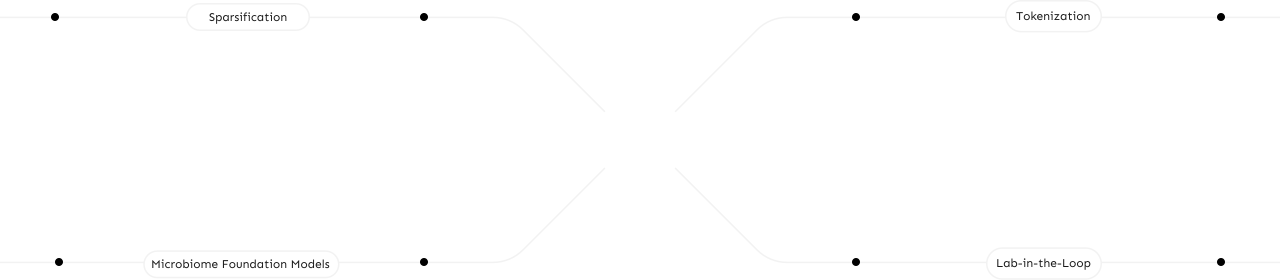
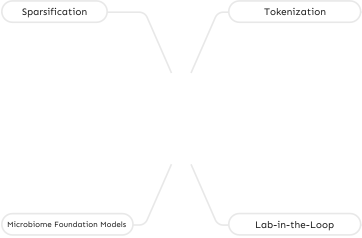
We've pioneered quality-aware, goal-directed sparsification algorithms. Microbiome data is ~99% noise. We remove noise and low-quality data through sparsification, leaving only the ~1% that actually carries predictive power. That's how we make the microbiome computationally tractable.
Causal Modeling of Microbial Ecosystems
We forecast ecosystem dynamics, predict counterfactual outcomes of interventions, and safe enable inverse design of microbial therapies.
Crossing the Scaling Wall
We build 10x larger models, causal reasoning, and generalization across organisms, environments, and interventions.
Observation to Intervention
We couple large-scale multi-omics with 100,000+ interventional trajectories and AI-guided lab-in-the-loop validation.
From Archive to Causality
Turning petabases of noisy sequences into usable causal signal.
the missing layer in drug development
Our Darwin model series enables the prediction of drug toxicity and efficacy across diverse populations and optimizes molecules for broader efficacy—addressing the hidden, microbiome‑driven causes of drug response and failure.
The Gut Microbiome Controls Drug Response
The gut microbiome contains trillions of bacteria that can fundamentally alter how drugs work in the body.
These microbes can:
- Metabolize drugs before they reach their targets, reducing efficacy
- Convert inactive compounds into active therapeutics
- Transform drugs into toxic metabolites, causing adverse reactions
- Modulate immune responses that affect drug tolerance
A Billion-Dollar Blind Spot
Despite decades of research showing microbiome-drug interactions, pharmaceutical development largely ignores this variable. Clinical trials fail to account for microbiome diversity across populations. Drugs that work in some patients fail catastrophically in others—not due to genetics, but because of the bacterial ecosystems in their gut.
This isn't a minor oversight. It's a fundamental flaw in how we approach precision medicine. We've mapped the human genome but remained blind to the bacterial genome that outnumbers our own cells 10 to 1.
Why Traditional Approaches Fail
The microbiome is complex—thousands of species, millions of genes, trillions of interactions. Traditional computational methods can't separate signal from noise at this scale. Machine learning models trained on noisy microbiome data produce unreliable predictions. The data is too sparse, too high-dimensional, and too confounded.
The result: drug development proceeds without understanding how the microbiome will influence outcomes. Billions are spent developing drugs that fail in diverse populations. Patients suffer from preventable adverse reactions. Effective treatments are abandoned because they don't work universally—when the real issue is microbiome variability.
Our publications
Foundational work in computational biology, AI, pharmacology.
.avif)

Researchers bridging computation, biology, and medicine
We’re second-time founders who have lived this problem and published at leading AI x biology venues.

Founder at Anto (YC F25) | Researcher at Broad, Harvard, MIT | Lecturer at ETH Zurich
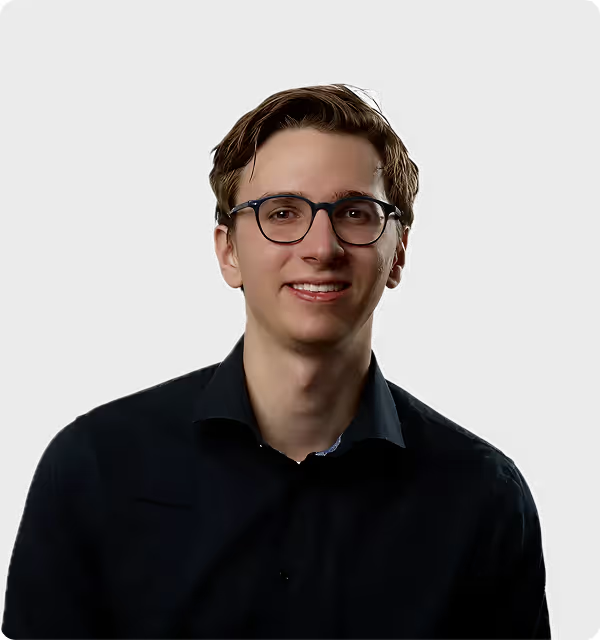
ETH Zurich, Harvard Medical School, J&J. Pharmacology x Gastroenterology
Making sense of the microbial world
Anto is building multimodal foundation models for microbial communities, making the gut microbiome computable for the first time. We predict drug toxicity and efficacy across diverse populations and optimize molecules for universal efficacy — addressing the microbiome-driven causes of drug response and failures.